
Merging Science and Tradition: A Community Approach to Springshed Management in Uttarakhand

Updated: May 28

2024 Best Paper Awarded by


Centre for Business and Entrepreneurial Development (CBED),
Dehradun, Uttarakhand, India
Authors:
1a) Anita Sharma: Project Manager
1b) Nitin Bharti1b: Field Assistant
2a) Ritu Shankar: Programme and Funding Coordinator
2b) Praveena Sridhar: Head of Programmes and Funding
1) Centre for Business and Entrepreneurial Development (CBED), Dehradun, Uttarakhand, India
2) Frank Water, Bristol, UK
Abstract
Nearly 50 percent of the 3 million springs in the Indian Himalayan Region (IHR) have either dried up or have become seasonal due to climate change and developmental activities (NITI Aayog, 2017). This "water tower," of Asia is rich in water resources but faces severe water scarcity challenges. About 50 million people live in the IHR (Chakraborty et al., 2022) and primarily rely on groundwater sources like springs and streams. Seventy-seven percent of Uttarakhand’s population resides in the high attitudinal hilly regions, of which 90% depend on natural spring water for daily activities (Jain et al., 2010).
The drinking water crisis is intensifying, with irregular piped water supplies exacerbated by frequent landslides, disproportionately affecting women with the burden of collecting water. Historically, these water sources thrived through traditions and community practices passed down through generations, promoting sustainability and effective natural resource management. However, native traditional knowledge is often overlooked due to the dominance of scientific perspectives and a lack of recognition of Indigenous expertise.
While modern hydrogeology accurately identifies spring recharge areas, there are too few trained professionals to work in rural mountainous regions making it a cost-intensive proposition. The pace of training these specialists lags behind the rapid climate changes and developmental activities threatening the springs.
In response, a community-based spring rejuvenation pilot program was launched in the Rudraprayag district of Uttarakhand in January 2024. This initiative seeks to merge native knowledge and scientific methods for spring management, with preliminary results showing increased spring discharge in both scientific and integrated approaches. This integrated approach can be refined and replicated to enhance spring rejuvenation across the IHR.
Introduction
In the Indian Himalayan Region (IHR), much of the rural population relies on the springs for domestic use and irrigation. However, in recent decades, many once-perennial springs have begun to dry up. Numerous studies have examined this phenomenon, attributing the decline of springs to factors such as changes in rainfall, land-use patterns, deforestation, forest fires, and soil erosion. These changes significantly hinder the infiltration of rainwater necessary for groundwater recharge (Valdiya and Bartarya, 1989, 1991; Negi and Joshi, 1996, 2004).
Various initiatives, including watershed development and the establishment of spring sanctuaries, have been implemented to revive these springs.
Such efforts, which focus on engineering, vegetative, and social measures to regenerate underground seepage, have shown promising results, particularly when the spring recharge areas are identified through hydrogeological studies (Negi and Joshi, 1998; Tambe et al., 2011; Sikkim Dhara Vikas, 2009-2011).
The Issue
In the recent decade, the efforts of numerous civil society organizations (CSOs), research institutes, and government bodies like the Niti Aayog have brought a regional focus on the revival of springs in the Himalayas using the principles of hydrogeology (Niti Aayog, 2018; Shrestha et al., 2018). Although hydrogeology is a precise science, there is a scarcity of professionals skilled in accurately demarcating potential spring recharge areas, making their services expensive. While various organizations offer training courses in spring hydrogeology, developing qualified professionals is lagging behind the rapid climate changes and developmental activities that threaten springs in the IHR and beyond.
Conversely, local communities have historically sustained themselves by conserving and optimally utilizing their natural resources and passing information on from one generation to another (Eisenberg, 2019). This knowledge, rooted in cultural practices and community experiences, is often overlooked.
This is the knowledge existing within and developed around the specific conditions of people Indigenous to a particular geographic area. In the IHR, such knowledge includes treating water sources as “sacred,” constructing temples at these sites, maintaining sacred groves, and employing methods to optimize water use and recharge springs. Incorporating Indigenous perspectives on ecology and land management is essential to creating resilient ecosystems and for their effective management (Garnett, et al., 2018; Kimmerer., 2000). However, Indigenous expertise is frequently overshadowed by dominant scientific perspectives.
The Approach
To address these challenges, an integrated approach that merges native knowledge with scientific techniques is essential. Modern science should support and enhance indigenous practices, focusing on the desired outcomes. Given the increasing demand for springshed management, capturing rainwater is crucial, even if methodologies lack precision. These efforts can still significantly recharge nearby groundwater aquifers, transforming water scarcity into abundance.
In January 2024, a community-based spring rejuvenation program was initiated in the Rudraprayag district of Uttarakhand integrating native knowledge and scientific methods. Preliminary results indicate increased spring discharge in integrated and scientifically identified recharge areas and treatment measures. This integrated approach holds promise for refinement and replication, enhancing spring rejuvenation throughout the Indian Himalayan Region.
Materials And Methods
Selection of spring sites for the two approaches
Following reconnaissance visits, the blocks of Augustmuni and Jakholi in Rudraprayag district, Uttarakhand, were chosen as pilot project sites (figure 1). These blocks have the highest dependency on spring water in the district. The springs serve as the primary water source for the selected villages, which rely on them for drinking water and agricultural needs. The villages experience a shortage of drinking water, particularly during the summer months.

Ten springs (eight in Augustmuni and two in Jhakoli block) across nine villages were selected (figure 2 and table 1). The final selection of villages and springs was based on low spring discharges and a high dependency of the villagers on the spring. The final nine villages comprised 1845 households with an estimated 11,070 people out of which around 30% of households (522) with an estimated population of 3300 people entirely depended on spring water for their daily needs. From these ten springs, four springs were randomly chosen for scientific rejuvenation based on hydrogeological studies, while six springs were selected for rejuvenation using an integrated approach that combines native and scientific knowledge.

The approaches broadly covered the activities listed in Figure 3. Some of the steps like recce visits to the villages and preparing the spring inventory were common in both the approaches.
Community involvement
The selection of sites was followed by the formation of a water and sanitation committee in each village. The committee primarily consisted of women members. This body was created through an open village discussion to ensure the active participation of villagers in spring treatment measures, maintenance of recharge areas, and plantation for soil and water conservation. Formation of committees was also common in both approaches.


Application of integrated and scientific approach
For the six springs selected for the integrated approach of treatment, information was collected from the villagers about the past and present status of springs, and land use changes that have disturbed the springs. The spring recharge areas were demarcated based on people’s perceptions. For example, changes in spring behaviour due to cutting of forest, landslide, earthquake, construction activities, or changes in the rainfall pattern, type of construction activities that have occurred in the recent past (roads, hotels, houses for settlements, etc., areas where such construction activities have negatively impacted the spring discharge.
For the four springs selected for using the scientific approach, the hydrogeological studies were conducted followed by engineering estimates. The major outcomes of the hydrogeological and engineering measures were listed and applied as the common protocols in the treatment of all ten springs. (figure 3). Staggered Contour Trenches (SCT) were constructed in the recharge areas. A total of 3297 trenches were dug of which 1465 were in the recharge areas of the four springs treated scientifically and 1832 were dug in the recharge areas of the six springs treated with an integrated approach. The size, spacing, and number of trenches were decided based on the type of land and the field situation. The details of the interventions are given in Table 1. This was followed by the villagers' planting 1000 saplings of oak, mountain ebony, and mulberry trees in the spring recharge areas.
Results
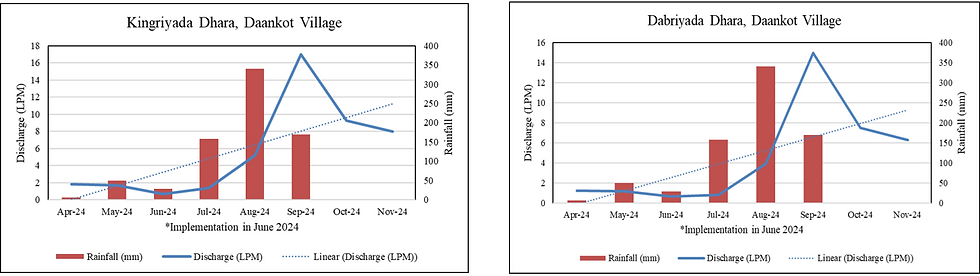
The spring hydrographs indicate a significant impact on discharge levels of all the springs treated with an integrated approach (Figures 4a and 4b) as well as with a scientific approach (figures 5a and 5b) following the recharge interventions in June 2024. The hydrographs demonstrate a clear correlation between rainfall and spring discharge. When rainfall increases, the discharge also increases, indicating the responsiveness of the springs to precipitation compared to pre-treatment months – April and May. Overall, the discharge trend is upward over the observed period for all ten springs.



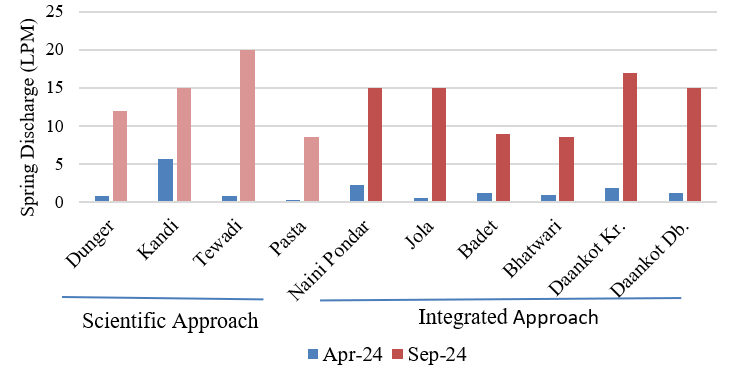
The overall data shows that spring discharge increased significantly from April to September for both the Scientific and Integrated treatment approaches (figure 6). However, the Integrated Approach generally led to higher discharge values in September. This suggests that while both methods effectively enhance spring discharge over time, the Integrated Approach might be slightly more impactful. Overall, all the springs showed positive responses to the interventions. A total of 3297 trenches dug created a total volume of 2016 cum. (table 1) which was several times more than the total water demand of the people as per the norms of 55 Litres Per Capita Per Day (LPCD) for rural areas under the Jal Jeevan Mission, GOI.
Discussion
The ongoing crisis of spring depletion in the Indian Himalayan Region (IHR) underscores the critical intersection of climate change, developmental pressures, and traditional water management practices. With nearly half of the region's springs experiencing reduced discharge or seasonal drying, it is imperative to evaluate the implications of this phenomenon for local communities and water sustainability.
Integration of Native Knowledge and Scientific Methods
This study highlights the potential for an integrated approach that combines native knowledge and scientific methodologies in spring management. Local communities possess invaluable insights gained through generations of interaction with their environment. These practices, including reverence for sacred water sources and maintaining sustainable land-use practices, offer a rich foundation for developing effective water management strategies. By incorporating these indigenous perspectives into modern scientific frameworks, the resilience of spring systems can be enhanced.
The pilot program exemplifies this integration. The spring recharge areas were identified based on local needs and historical knowledge of water sources, followed by targeted engineering interventions. This dual approach enhances the likelihood of successful spring rejuvenation and fosters community ownership and responsibility for water resources.
Community Involvement and Empowerment
Forming water and sanitation committees predominantly composed of women is a significant step toward empowering local communities. Women, who are often the primary water collectors, play a crucial role in water management decisions. Their involvement ensures that the initiatives are tailored to the community's specific needs and enhance the social fabric around water governance. Engaging local populations in the decision-making process cultivates a sense of stewardship, which is essential for the long-term sustainability of water resources.
The success of community-driven initiatives is evident in the positive preliminary results of increased spring discharge observed after the interventions. This demonstrates that when communities are actively involved in the management of their resources, they can effectively address challenges posed by environmental changes.
Challenges and Future Directions
Despite the promising results of integrating native knowledge with scientific practices, several challenges remain. The shortage of trained hydrogeologists and the high costs associated with scientific interventions hinder the scaling of such programs. Moreover, the rapid pace of climate change demands urgent action, necessitating a more agile response from both local communities and governmental organizations.
Future efforts must focus on building capacity within local communities, and training individuals in both scientific and indigenous water management practices. This can create a network of local experts who understand the intricacies of both approaches, facilitating a more nuanced response to water scarcity challenges.
Additionally, there is a need for broader policy recognition of the value of traditional knowledge in water management. Integrating these practices into national and regional water policies can promote a more holistic approach to resource management that respects and utilizes local expertise.
Conclusion
The integrated approach to spring rejuvenation in the IHR showcases a pathway for addressing the pressing water scarcity issues facing these communities. By bridging native knowledge and scientific methods, we can foster resilience in spring systems, empower local communities, and create sustainable solutions to ensure water security for future generations. As the region continues to grapple with the impacts of climate change and development, this collaborative model offers hope for revitalizing the essential water resources that underpin the livelihoods and cultures of millions in the IHR.
Acknowledgment
The authors extend heartfelt gratitude to Frank Water UK for generously funding this project and enabling the practical implementation of the integrated approach in the field. Our appreciation also goes to the dedicated field staff, whose invaluable contributions and efforts were crucial to the successful completion of this study.
References
Chakraborty, P.and Ghosal, S. (2022). Status of mountain-tourism and research in the Indian Himalayan Region: a systematic review. Asia-Pac J Reg Sci 6, 863– 897 (2022). https://doi.org/10.1007/s41685-022-00243-w
Eisenberg, C. 2019. Defining and Integrating Traditional Ecological Knowledge to Create a More Sustainable Earth. Bull Ecol Soc Am 100(4):e01585. https://doi.org/10.1002/bes2.1585.
Garnett, S. T., et al. 2018. A spatial overview of the global importance of indigenous lands for conservation. Nature Sustainability 1:369–374.
Goswami R., Gangwar AK. Dhara Vikas’ (Rejuvenation of springs) in Sikkim, Eastern Himalaya, Task Force- 5, Department of Science & Technology.
Jain, C. K., Bandyopadhyay, A. & Bhadra, A. (2010). Assessment of groundwater quality for drinking purposes, District Nainital, Uttarakhand, India. Environment Monitoring Assess 166, 663–676.
Kimmerer, R.W.2000. Native knowledge for native ecosystems. Journal of Forestry 98:4-9.
Negi G., Joshi V., (1996). Geohydrology of springs in a mountain watershed: the need for problem-solving research, Current Science 71, 772-776.
Negi, G. C. S., V. Joshi, and K. Kumar. 1998. Spring sanctuary development to meet household water demand in the mountains: a call for action. In: G. B. Pant Institute of Himalayan Environment and Development. Research for Mountain Development: Some Initiatives and Accomplishments Kosi-Almora, India: G. B. Pant Institute, pp. 25–48.
NITI Aayog (2017). Report of the NITI Aayog Working Group on Himalayan Springs.
NITI Aayog (2018): Report of Working Group I Inventory and Revival of Springs in the Himalayas for Water Security
Shrestha, R. B., Desai, J., Mukherji, A., Dhakal, M., Kulkarni, H., Mahamuni, K., Bhuchar, S., & Bajracharya, S. (2018). Protocol for reviving springs in the Hindu Kush Himalayas: A practitioner’s manual. International Centre for Integrated Mountain Development (ICIMOD).
Tambe, Sandeep & Arrawatia, M.L. & Bhutia, Nima & Swaroop, Brijendra. (2011). Rapid, cost-effective, and high-resolution assessment of climate-related vulnerability of rural communities of Sikkim Himalaya, India. Current science. 101. 165-173.
Valdiya KS., Bartarya SK. (1991) Hydrological studies of springs in the catchment of the Gaula River, Kumaun Lesser Himalaya, India. Mt Res Dev 11(3):239–258.
Valdiya KS., Bartarya SK. (1989) Diminishing discharges of mountain springs in a part of Kumaun Himalaya. Current Sci 58(8):417–426. ISSN 0011-3891.


