
World Water Day: “Women and Water” Water Management in the U.S.

Updated: May 23
By Ayo O. Shanti
Founder/Director - World Water Hub
Haryana State Pollution Control Board 

World Water Hub
Report on Water Management in the U.S.
1) Women in the development of sewage, grey water, and pollution control systems.
2) Shifting approaches to the challenges of industrial waste and water pollution.
3) Systems: from small local, to large urban, to industrial waste pollution control.
4) Different methods for different challenges.
5) Developing and emerging methods and possibilities.
6) Sludge and heavy metals: treatment and safe disposal.
7) The importance of engaging all stakeholders.
Women in the development of Sewage, Grey Water, and Pollution Control Systems
Ruth Patrick: She showed how biodiversity (such as algae and insects) could be indicative of pollution levels. She developed integrated biological monitoring of water quality and helped shape modern environmental regulation, leading to the Clean Water Act approach in the U.S. for accurate detection and an understanding of the ecosystem.
Deepika Kurup: She developed a solar-powered photocatalytic water-purifying system (using sunlight and engineered materials that degraded organic pollutants and killed bacteria. It was a low-cost and scalable solution for contaminated water/wastewater. It is a decentralized, sustainable treatment.
Linda Weavers: She developed a system of ultrasound (sonochemistry) and ozone/UV to break down contaminants. Focused on: pharmaceuticals, industrial chemicals and “emerging contaminants.” This enhanced traditional treatment plants by degrading the pollutants that were resisting conventional methods.
Women researchers and women-led research teams developed and advanced: Nano-remediation and nano-adsorbents and catalysts - using nanoparticles (e.g., nano zero-valent iron) to neutralize or immobilize pollutants. This is already being used at contaminated groundwater sites in the U.S.
Women microbiologists and engineers contributed: to the bioremediation systems using bacteria and biofilm reactors for wastewater. For example: bacteria-based systems are now being developed to remove PFAS from water. This targets pollutants that traditional filtration systems cannot remove. It also uses less energy and is more sustainable than chemical treatments.
Joelle Scott: developed the vapor-phase synthesis of advanced materials for wastewater treatment.
Women (including Linda Weavers): were key contributors to the development of advanced oxidation processes (AOPs) which combine UV light, ozone and hydrogen peroxide. They helped in scaling and optimizing these systems, which removed trace contaminants like pharmaceuticals and endocrine disruptors.
Women helped develop: New techniques, now global, but adopted and tested in the U.S. for magnetic removal of microplastics and Advanced filtration membranes to target pollutants that traditional plants miss.
Women were particularly influential in:
1) Sustainable and low-energy solutions: solar purification; biological systems (such as microbes and plants).
2) Tackling invisible pollutants: pharmaceuticals; PFAS; microplastics
3) Hybrid technologies: combining biology, chemistry and nanotechnology; multi-stage treatment systems.
4) Monitoring and treatment integration: smart sensors; AI; and real-time water quality tracking, which improves the efficiency of pollutant breakdown and filtration for next-generation treatment systems.
Gitanjali Rao: Smart sensing and pollution detection (a pre-treatment innovation) with a “Tethys” device that uses carbon nanotubes to detect lead in the water, creating real-time monitoring, bringing faster intervention and treatment decisions.
Women also contributed to some major innovations:
1) Biochar and bioreactor hybrid systems: wood-chip bioreactors (removes 77% nitrogen); modified biochar (removes 99% phosphorus and drugs); targets pharmaceuticals in wastewater; prevents algal blooms, addresses nutrient pollution.
2) Bioremediation (microorganisms), by using microbes to degrade pollutants (such as oil spills; industrial wastewater; agricultural runoff). This is widely used in U.S. cleanup projects.
3) U.S. plants combine UV and ozone advanced oxidation to destroy chemicals and microbes. Ozone systems are installed in water treatment plants across the U.S., especially in large municipal systems.
Women helped develop and improve the biological systems: Large wastewater treatment plants are using biological systems, relying on microbial treatment:
1) Jones Island Water Reclamation Facility uses bacteria to digest pollutants in wastewater before releasing the cleaner water back to Lake Michigan.
2) Sacramento Regional Wastewater Treatment Plant (serving over a million people and treating large volumes of wastewater daily) - incorporating biological treatment systems and advanced filtration - which are the core of modern water-pollution cleanup.
3) Newer treatment strategies that combine filtration, oxidation and reuse: Advanced Water Purification Facility (Oxnard, CA) cleans wastewater to very high standards to be reused for irrigation and groundwater recharge. Facilities such as this are becoming common in the western U.S. due to drought and water scarcity.
4) Major regional treatment systems that are multi-technology based: combinations of filtration, chemical treatment, and advanced oxidation: Metropolitan Water District of Southern California - several large treatment plants that serve 19 million people - and adopting technologies such as: ozone oxidation; advanced filtration membranes; and UV disinfection.
5) Solar-based purification innovations (such as Deepika Kurup’s) are being used and solar photocatalytic purification systems are still emerging: they are usually tested in: Universities; pilot projects, small or decentralized treatment systems. The technology of combining filtration with photocatalytic oxidation has been proposed as a low-cost wastewater treatment option for research done in the U.S. Usually tested in: university research labs; small-scale pilot projects; rural or decentralized systems.
Following are the geographic areas of the different treatment systems and innovations:
California: advanced purification, water recycling, and large ozone systems
New York region: large UV disinfection plants.
Midwest (Wisconsin): large biological wastewater treatment systems.
Massachusetts and the Northeast: advanced municipal treatment infrastructure.
Nationwide (42 states): ozone and advanced oxidation technologies.
Shifting approaches to the challenges of industrial waste and water pollution.
There has been a shift in the approach to water management and treatment of water pollution: from an attitude of “treat and dump” without seeing the whole picture. Now it is more focused on ecological impact with the approach of “treat, reuse and recover value.”
- Reuse water
- Recover resources
- Treat waste as part of production (rather than as a casual afterthought).
Industries that are successful in managing their wastewater and pollution control:
- Treat water as a resource, not as waste
- Reuse water internally for: cooling, cleaning and processing
- Use advanced technology adoption: membrane filtration (UF, RO); Ozone/UV; biochar and biological systems.
- Have a strong regulation compliance: EPA standards push innovation: Industries invest to avoid fines and shutdowns.
- Resource recovery: energy (biogas), fertilizers
- Producing renewable energy (biogas)
- Creating biochar for soil improvement
NOTE: Currently, with the Administration, the EPA has been diminished, but it is still managing to do what it can (what it is allowed to do) and the people are beginning to appreciate how important it is to the functioning of our infrastructure and our environment.
Examples of Wastewater Treatment Systems in the USA
1) Owego, Kansas (a case study)
Lagoon treatment and reuse
Treating wastewater and reusing it to irrigate a golf course
It helps to reduce the demand for drinking water
It is a drought-resistance water supply
It is low cost, simple tech (for small communities)
Works well with reuse approaches
2) Riverside Park Water Reclamation Facility (in Spokane, WA)
Large-scale advance treatment plant
The capacity is up to ~150 million gallons per day
It upgrades advanced membrane filtration, which improves water quality and public Health.
It eliminated raw sewage discharge, which previously caused disease outbreaks
It currently contributes to river flow during low water periods.
3) Denver Direct Potable Reuse Project (in Colorado)
Turns wastewater into drinking water
Has demonstrated that it is technically feasible and safe.
This pioneered direct reuse in the U.S., needed in water-scarce regions.
4) Tilman Water Reclamation Plant (in Los Angeles, CA)
Processes ~80 million gallons per day
It feeds lakes and rivers
Produces recycled water for reuse
Contributes a large part of flow to the L.A. River
Demonstrates that urban plants can simultaneously support ecosystems and
water reuse.
5) Oceanside Water Pollution Control Plant (in San Francisco, CA)
Built underground inside a hill
Processes ~65 million gallons per day
Treats wastewater and safely discharges it offshore
Demonstrates how a treatment plant can minimize the visual and
environmental impact while handling large volumes.
6) Grand Canyon Water Reclamation Plant (in Arizona)
This is an early example (built in 1926)
It reused wastewater for: irrigation, toilets and industrial uses.
This is an established long-term strategy.
7) Marinette, Wisconsin Wastewater Plant
Uses advanced dewatering and drying technology to address
PFAS contamination in sludge
It reduced the sludge volume, lowered disposal costs and created
safer handling of the contaminants.
While the systems are geared towards local needs, reuse is a key aspect for: irrigation, river and ecosystem support and drinking water. Technology upgrades are important for: membrane filtration, advanced sludge processing and contaminant-specific treatment.
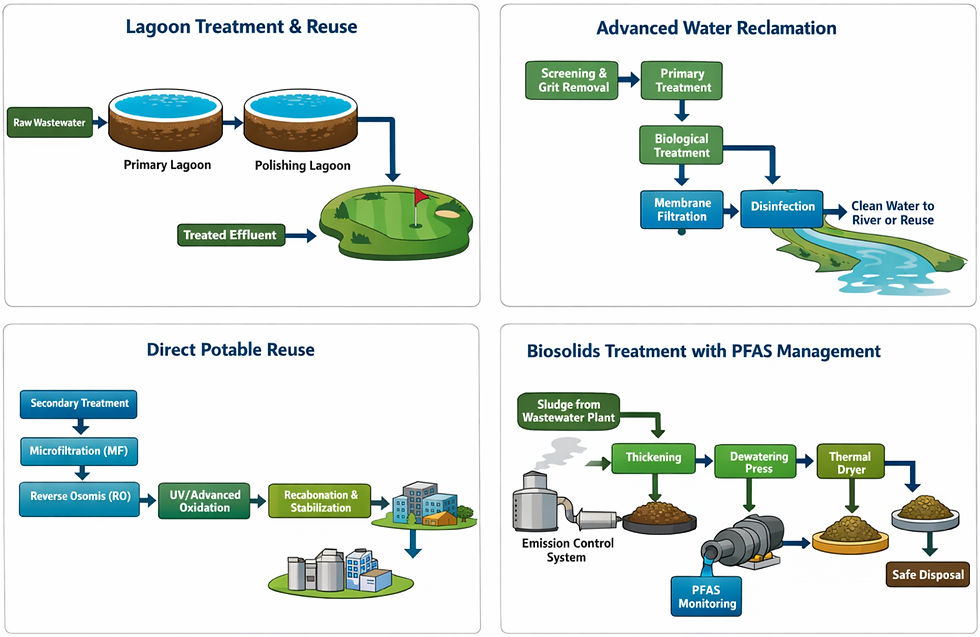
Systems: from small local, to large urban, to industrial waste pollution control.
1) Lagoon wastewater treatment uses natural processes such as sunlight, bacteria, algae and oxygen, which breakdown organic waste in large ponds or lagoons. The wastewater flows into a primary lagoon for the bacterial digestion, then it passes to the secondary storage lagoon for settling and storage before the final and safe discharge into the environment. This is used primarily in rural areas for small communities, private homes, local social clubs, sports fields and golf courses. They are also used for animal farms, where the resulting methane gas is also captured, transformed and used for energy. Lagoons require more land, don’t work as well in cold air, not good at removing toxins and removing sludge can be a problem and add to the cost.
2) For large urban wastewater systems, there are three or more treatment stages:
- The primary stage: is to screen out and remove solids and grit and the effluent goes into a settling tank where grease and scum rise to the surface and other solids and toxins settle in sedimentation and sink to the bottom as sludge. The floating materials are removed mechanically with rotating paddles that push the floating grease and scum into a collection trough (scum box or scum hopper) and then pumped to separate handling units (usually pumped to sludge digesters or scum treatment systems. Sometimes it is blended with primary sludge for further stabilization (e.g., anaerobic digestion). This prevents clogging and interference with aeration equipment, improves oxygen efficiency in aeration tanks, and reduces the load on biological treatment processes.
- The secondary stage: for biological wastewater treatment includes the aeration tank, which separates the biological solids (microorganisms) from the treated water. The effluent enters the clarifier tank as mixed liquid (water and suspended microbial flocs formed during aeration). Since the flocs are heavier than water, they can settle under calm conditions (the tank is designed to be very low turbulence so gravity can work) and the microbial flocs can settle to the bottom and form activated sludge. The upper layer becomes clear effluent, while a slow-moving rake mechanism rotates along the bottom and pushes settled sludge into a central hopper. A portion of the settled sludge is pumped back to the aeration tank in order to maintain a high concentration of microorganisms needed for treatment. Excess sludge if removed as Waste Activated Sludge (WAS) and sent to sludge treatment (e.g., digestion). The clarifying tank also has surface skimmers to remove any floating solids that escaped earlier stages.
- The tertiary stage: the clarified water flows over weirs at the tops of the clarifying tank and then goes to disinfection or tertiary treatment. Most clarified effluent goes through disinfection before discharge:
- chlorination
- UV treatment
- ozonation
This step removes pathogens even if no tertiary treatment is used.
- Advanced tertiary treatment:
- when nutrient (nitrogen and phosphorus) removal is needed
- when higher quality water is needed:
Nutrient removal
Filtration of fine suspended solids
Water reuse (irrigation, industrial use, or potable reuse)
- typical tertiary processes (polishing) include:
Sand or membrane filtration
Chemical precipitation (for phosphorus)
Biological nutrient removal (advanced systems)
- The resulting “polished” water is discharged or reused.
3) For Industrial wastewater: The forms for wastewater treatment depend on the industries and the materials used in the production of their products. Most need at least the three levels of treatments, and some require extra levels, especially when dealing with highly toxic materials, with heavy metals and contaminants and with contaminated sludge. The essential step is to create a clear assessment of the materials used, their toxicity (especially with heavy metals and pharmaceuticals).


Different methods for different challenges.
1) Advanced filtrations: (beyond sand)
- Microfiltration (MF):
Pore size ~0.1 - 10 microns
Removes: suspended solids and bacteria
Pretreatment before more advanced steps
- Ultrafiltration (UF)
Pore size ~0.01 - 0.1
Removes: bacteria, protozoa, and some viruses
For drinking water and reuse systems
- Nanofiltration (NF)
Even smaller pores
Removes: dissolved organic compounds and some salts
For softening water and removing micropollutants.
- Reverse Osmosis (RO)
Tightest filtration (molecular level)
Removes: salts, heavy metals, pharmaceuticals, and nearly
all contaminants
For: drinking water production; desalination, and direct potable reuse
- Activated Carbon filtration:
Though it’s not a membrane, it is still “advanced”
Uses adsorption (it sticks contaminants to the surface)
Removes: chlorine, odors and taste, and organic chemicals
2) How advanced filtration treatments might be used in a wastewater system:
Secondary treatment (biological cleanup)
(MF) and (UF) to remove particles and microbes
(RO) to remove dissolved contaminants
UV or ozone for final disinfection
(Often combined in water reuse projects in California and other places)
3) Reasons for using advanced filtration:
It enables safe water reuse (even for drinking water)
It removes contaminants that traditional wastewater plants can’t
It protects ecosystems from micropollutants
It’s essential for dealing with emerging contaminants (like PFAS and pharmaceuticals)
3-a) The advantages:
It’s extremely effective and reliable
It produces very high quality water
It is scalable (used in both small and large systems).
3-b) The limitations:
Expensive to build and operate
Membranes can clog (“fouling”)
Requires energy (especially RO)
Produces concentrated waste (brine)

4) How UV disinfection works:
After filtration, water passes through a UV chamber, past UV lamps
UV light penetrates bacteria, viruses, and protozoa
UV light damages the organisms DNA or RNA
It prevents them from reproducing, thus they can’t cause infection
Microorganisms aren’t always killed right away, but they’re rendered harmless
- UV is effective against:
Bacteria (E. coli)
Viruses
Protozoa (Giardia and Cryptosporidium - chlorine doesn’t work well with those)
Often used instead of or along side of chlorine or ozone
Usually part of the final tertiary treatment, after solids removal and filtration.
- Advantages of UV:
No chemicals added
No harmful disinfection byproducts
Works quickly (in seconds)
Very effective against chlorine-resistant organisms
- Limitations of UV:
Water must be clear (turbidity blocks UV light)
No residual protection (unlike chlorine which stays in the water)
Requires electricity and maintenance.
5) How ozone oxidation works:
Electricity (corona discharge or UV light) converts oxygen (O2) into ozone (O3)
Ozone gas is bubbled through wastewater or drinking water
Ozone (O3) is a highly reactive form of oxygen
It’s unstable and quickly reacts by direct oxidation, breaking down contaminants
Or indirect oxidation by forming hydroxyl radicals (+OH), which are more powerful oxidizers, which can break apart organic molecules, destroy bacteria and viruses, and neutralize chemicals like pesticides and pharmaceuticals.
- Ozone removes:
Pathogens (bacteria, viruses, protozoa)
Organic pollutants (dyes, pharmaceuticals, PFAS precursors)
Odors and taste compounds
Color in water
Micropollutants that traditional treatment can miss.
- Ozone is used as a part of advanced tertiary treatment for:
Water reuse projects
Drinking water plants that need high level disinfection
Facilities dealing with emerging contaminants
And often paired with filtration (sand or membranes) UV disinfection or Activated carbon.
- Advantages of Ozone oxidation:
It’s stronger than chlorine as an oxidant
Works quickly (seconds to minutes)
Leaves no long-term chemical residue (it breaks back into oxygen)
It improves water clarity, taste, and smell)
- Limitations of Ozone oxidation:
It’s more expensive than traditional disinfectants
It must be generated on-site (it can’t be stored easily)
It can form byproducts (like bromate) if not controlled.
Developing and emerging technologies.
1) Photocatalytic purification is an advanced water treatment method:
It uses light + a catalyst (usually titanium dioxide, TiO2) to break down pollutants into harmless substances
Light energy (usually UV) activates a material (the photocatalyst)
The catalyst triggers powerful chemical reactions that destroy contaminants
It chemically breaks them apart
The energized catalyst creates: Hydroxyl radicals (+OH); superoxide ions
They attack contaminants and convert them into: CO2, H2O and other harmless byproducts
- Photocatalytic purification removes:
Organic pollutants
Pharmaceutical residues
Bacteria and viruses
Air pollutants (it’s also used in air purification systems)
- Where Photocatalytic purification is being used:
Pilot wastewater treatment systems
Industrial wastewater cleanup
Self-cleaning surfaces (coatings on glass or concrete)
Advanced water reuse research projects
- Advantages of using photocatalytic purification:
It can completely mineralize pollutants (not just remove them)
It works at low temperatures and pressures
It uses light as an energy source (potentially solar)
Effective on hard-to-remove micropollutants
- Limitations of using photocatalytic purification:
It’s slower than ozone or UV alone in some cases
It requires UV light (though visible light catalysts are being developed)
Catalyst surfaces can foul over time
Still working on scaling up for large municipal systems
2) Biochar and bioreactor hybrid systems are an emerging approach: They are an eco-friendly approach to water and wastewater treatment in the U.S.
Biochar is made by heating organic waste (like wood, crop residues, or manure in low oxygen (by a process called pyrolysis).
- It is highly porous
- It has a large surface area
- It can adsorb or trap contaminants
- It supports the growth of beneficial microbes
A bioreactor system is where microorganisms break down pollutants in water.
- In activated sludge tanks
- In packed-bed reactors
- In moving bed biofilm reactors (MBBRs)
- Microbes in these systems “eat” contaminants (such as organic waste and nutrients).
In a biochar-bioreactor hybrid system:
- Biochar is added into or used as the medium inside a bioreactor.
- Biochar in the system acts as a support, a filter, and an adsorbent
Adsorption with Biochar: it quickly captures pollutants:
- heavy metals;
- nutrients (nitrogen and phosphorus);
- organic chemicals.
Microbial degradation with biochar:
- Microbes grow on the biochar surface;
- They break down trapped pollutants over time.
Biochar-bioreactor hybrid system regeneration effect:
- Biochar surfaces are “freed up” as microbes degrade pollutants;
- This makes the system longer-lasting and more efficient.
These biochar-bioreactor hybrid systems are effective in removing:
- Nutrients (nitrogen and phosphorus) which reduces algal blooms,
- heavy metals,
- organic pollutants (including some pharmaceuticals),
- stormwater contaminants,
- agricultural runoff (nitrates).
These biochar-bioreactor hybrid systems are increasingly used in:
- Agriculture (in the Midwest and California);
- treating farm runoff before it reaches rivers;
- reducing nitrate pollution.
- Stormwater management (urban areas):
- Use biochar filters in: rain gardens; green infrastructure systems
- Wastewater pilot projects: Universities and utilities are testing hybrid systems for:
- nutrient removal
- removal of PFAS and emerging contaminants.
Advantages of biochar-bioreactor hybrid systems:
- Sustainable (uses waste biomass);
- Lower energy use than advanced chemical systems,
- Combines physical and biological treatment,
- Can improve microbial efficiency,
- Helps to address nonpoint source pollution (such as runoff).
Limitations of biochar-bioreactor hybrid systems:
- Still emerging at large municipal scale,
- Performance depends on biochar quality,
- Needs periodic replacement or regeneration,
- Not as precise as membrane filtration for drinking water
Sludge and Heavy Metals: treatment and safe disposal.
Sludge is the solid material removed from wastewater, including:
- organic matter (waste, food, etc.),
- microorganisms,
- heavy metals and contaminants.
Sludge must be treated and stabilized before disposal: Steps to making sludge safe:
Thickening:
- water is removed to concentrate the solids,
- it makes sludge easier to handle.
Stabilization to reduce pathogens and odors - common methods:
- Anaerobic digestion: microbes break down sludge without oxygen, Produces biogas (methane) for energy
- Aerobic digestion: uses oxygen instead:
- Lime stabilization: raises pH to kill pathogens
- Dewatering: removes water using:
Centrifuges,
Belt filter presses,
Turns sludge into a cake-like solid.
- Drying (optional, though common):
Heat drying or air drying, further reduces moisture,
Easier to transport or reuse.
Final disposal and reuse methods in the U.S.
1) Land application (the most common):
Treated sludge (biosolids) is used as fertilizer:
Applied to:
- Farms
- Forests
- Land reclamation sites
- It’s safe when treated properly
- NOTE: strict rules limit metals and pathogens.
2) Landfills:
Sludge is buried in controlled landfill sites
This is used when contamination is too high for reuse.
3) Incineration:
Sludge is burned at high temperatures
This drastically reduces the volume
It can generate energy
It requires air pollution controls.
4) Emerging advanced thermal processes: Pyrolysis/ gasification:
Converts sludge into:
- Biochar
- Fuel gases
Helps destroy contaminants like PFAS (still in development)
5) Construction reuse:
Ash or treated sludge used in:
- Cement
- Bricks
Regulations (important): In the U.S. sludge disposal is regulated by:
EPA 40CFR Part 503 (biosolids Rule), which sets limits on
Pathogens
Heavy metals
Application methods
Safety concept - goal: turn sludge into something that is:
Biologically safe (no harmful pathogens);
Chemically controlled (low toxins);
Environmentally useful or contained.
Modern wastewater systems try to move from “waste disposal” to “resource recovery”
Turning sludge into fertilizer
Producing renewable energy (biogas)
Creating biochar for soil improvement
There are industries in the U.S. that are successfully treating and reusing their industrial wastewater and turning it from a liability into a resource:
Following are examples from key industries that are leading the way:
1) Food & Beverage Industry: PepsiCo
Reuses up to ~80% of its process water in some plants
Uses:
- biological treatment
- Membrane filtration
- Water recycling systems
They succeed because:
- high water use is a strong incentive to recycle
- wastewater is mostly organic and therefore easier to treat biologically
2) Pharmaceutical and Medical Industry:
Wastewater contains:
- Chemicals
- Solvents
- Biological residues
They use advanced systems like:
- Ozone oxidation,
- Activated carbon,
- Membrane filtration.
These industries must meet strict FDA and EPA standards, so they invest heavily in high-tech treatment.
3) Oil and Gas Industry produces complex wastewater with:
Hydrocarbons
Salts
Drilling chemicals
They use treatment methods:
Evaporative systems,
Reverse Osmosis (RO),
Zero Liquid discharge (ZLD).
Reusing water reduces costs in remote drilling operations.
4) Chemical Manufacturing Industry - are among the most advanced users of water recycling:
Industry-wide, facilities reuse large portions of water through:
Closed-loop systems
Advanced filtration
Ion exchange.
Some systems can reduce freshwater use by ~90% in optimized setups.
5) Agriculture and Dairy Industry - Sedron Technologies
Treats manure and agricultural wastewater:
Converts waste into:
- clean water,
- fertilizer,
- energy.
Turns waste into valuable products (moving towards a circular economy).
6) Municipal-industrial Partnerships: Milwaukee Metropolitan Sewerage District
Works with industries and communities
Achieves ~98% wastewater capture and treatment rate
Success is based on regional systems, strict regulation, and innovation.
7) Manufacturing (General and Heavy Industry):
Includes:
Metal finishing
Electronics
Textiles
Common Strategies:
On-site treatment plants,
Chemical precipitations (for metals),
Membrane filtration,
Goal is to meet discharge limits and reuse water internally.
Heavy Metals Processing
There are water treatment plants and facilities in the U.S. that are effective at removing heavy metals (such as lead, arsenic, cadmium, chromium, and mercury) ranging from municipal drinking- water plants to industrial cleanup facilities and Superfund remediation systems.
1) Savannah River Site-Effluent Treatment Facility (South Carolina)
At the Savannah River site,
Treats contaminated water from nuclear and industrial processes,
Heavy metals removed (including metals and radioactive contaminants),
Uses multi-stage treatment (filtration, chemical treatment and adsorption),
Designed to remove heavy metals and hazardous chemicals before water is released into natural waterways.
2) Devils Lake Wastewater Treatment (North Dakota)
Uses plant-based (bioremediation) systems,
Heavy metals removed (lead, arsenic, zinc, copper),
Uses aquatic plants (like duckweed) that absorb metals from water,
Can remove 70-90% of some heavy metals.
3) Municipal drinking water plants (nationwide)
These explicitly target heavy metals, especially arsenic.
John J Carroll Water Treatment Plant uses:
- Ozone treatment
- UV disinfection
- often paired with adsorption/filtration
U.S. plants commonly use:
- ion exchange systems,
- Ferric-based adsorption media.
These technologies can reduce arsenic and other metals to below EPA safety limits.
4) Arsenic-removal systems (used in many U.S. plants)
Used in small town and wellhead systems,
Uses Granular ferric hydroxide (GFH filters),
Remove arsenic and other heavy metals using adsorption,
Widely installed to comply with U.S. drinking water regulations.
5) Superfund and Industrial cleanup sites - these are some of the most aggressive heavy metal treatment operations: Alabama Plating Company Superfund Site,
Contaminants: arsenic, cadmium, chromium lead, nickel and zinc,
Using pump-and-treat systems, chemical precipitation, and filtration,
Treatment plants specifically designed for heavy metal contamination.
Technologies used in these plants:
1) Adsorption
iron-based media (captures arsenic and lead),
activated carbon variants.
2) Ion exchange
Swaps harmful metal ions with harmless ones,
Highly effective for arsenic, uranium, nitrate.
3) Chemical precipitation
Converts dissolved metals into solids that can be filtered out
4) Reverse Osmosis (RO)
Physically removes dissolved metals through membranes
5) Bioremediation (an emerging technology)
Plants or microbes absorb metals from water.
Heavy metal removal is already happening at scale in the U.S.
It is most common in municipal drinking water systems (arsenic and lead removal),
Industrial and nuclear cleanup facilities,
Superfund remediation sites,
Many systems achieve high removal efficiency (90-99%) depending on the method.
Basic steps towards building a good industrial wastewater system
1) Assess the impact of the industrial infrastructure and its production on the environment and the local community.
2) Maintain knowledge, keeping a list of contaminants and pollution, and new developments and solutions. Budget for potential challenges. Keep up on current solutions to managing contaminants and pollution. Maintain a list of best ways to address these. Develop an effective emergency response system and have all stakeholders be part of it.
3) Create a collaborative stakeholder’s group (industrial, community, science, and engineers) to address challenges that may come up. And create a well-functioning communication system.
4) Communication, knowledge, collaboration, and awareness are key to navigating the challenges.
Industries that are successful in managing their wastewater and pollution control:
- Treat water as a resource, not as waste
- Reuse water internally for: cooling, cleaning and processing
- Use advanced technology adoption: membrane filtration (UF, RO); Ozone/UV; biochar and biological systems.
- Have a strong regulation compliance: EPA standards push innovation: Industries invest to avoid fines and shutdowns.
- Resource recovery: energy (biogas), fertilizers
- Producing renewable energy (biogas)
- Creating biochar for soil improvement


